Velia is the archaeological park of ancient Elea, a Greek colony founded around 540 BC at Ascea Marina in the Cilento. Parmenides and Zeno lived here, and the site preserves the Porta Rosa, considered the oldest round arch in Italy. Entry is included in the Paestum ticket, valid for three days; from our B&B it is about an hour's drive.
Compared with Paestum, Velia is less monumental and far less crowded: a hillside site overlooking the sea where you often find yourself almost alone among the ruins. It is worth the trip for three reasons: the history of philosophy, the Porta Rosa and the landscape of the Cilento coast.
Who founded Elea and why is it now called Velia?
The city was born of an escape. Around 540-535 BC a group of Greeks from Phocaea, on the coast of present-day Turkey, left their home as the Persians advanced. After stops in Corsica and at Rhegion, the Phocaeans settled on this Tyrrhenian headland and founded Hyele, later called Elea in Greek and Velia in Roman times.
Elea never became a military power like other colonies of Magna Graecia. Its fame rests on ideas: this is where the Eleatic school, one of the most influential currents of Greek philosophy, was born. A local tradition also credits the city with a medical school, which some scholars link in spirit to the later Salerno School of Medicine; it is an appealing hypothesis rather than an established fact.
Who were Parmenides and Zeno of Elea?
Parmenides, born in Elea around 515 BC, wrote a poem in hexameters, On Nature, of which fragments survive. In it he separates the way of truth from the way of opinion and places Being at the centre: one, unchanging and eternal. If Being cannot arise from nothing nor dissolve into nothing, then the change we perceive with our senses is mere appearance. Plato named a dialogue after him, the Parmenides, and Aristotle counted him among the founders of the inquiry into being.
"Being is, non-Being is not: this is the path of persuasion, for it attends upon truth."
— Parmenides, On Nature, fr. 2 (paraphrase)
His pupil Zeno, born around 490 BC, defended his master's teaching with a series of famous paradoxes:
- Achilles and the tortoise: if the tortoise has a head start, Achilles can never catch it, because each time he reaches the spot where it was, it has already moved a little further on.
- The dichotomy: to cover a distance you must first cover half of it, then half of the remaining half, and so on to infinity.
- The arrow: at every instant an arrow in flight occupies a space equal to itself, so at every instant it is at rest.
These arguments kept philosophers and mathematicians busy for centuries; a rigorous answer only came with the tools of infinitesimal calculus. Walking on the hill where they were first put forward gives the visit a different flavour from any other archaeological site in the area.
What is the Porta Rosa and why does it matter?
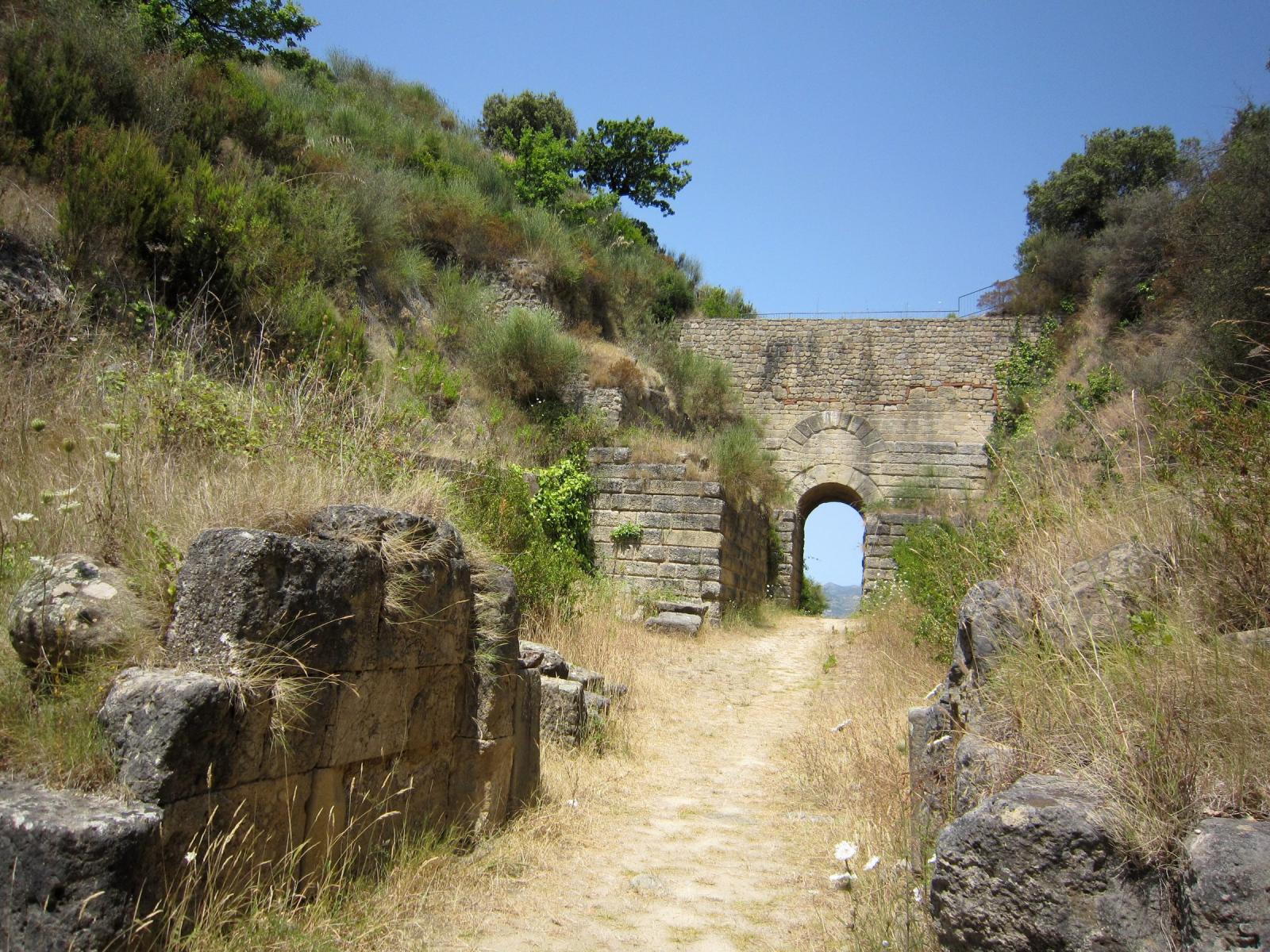
The Porta Rosa is the emblem of Velia. Its name has nothing to do with the colour of the stone: the structure was uncovered on 8 March 1964 by the archaeologist Mario Napoli, who named it in honour of his wife, Rosa. The German engineer W. Schleuning had already suggested that a city gate stood on this spot.
Despite the name, it is not really a gate but a viaduct: a dry-stone arch with a semicircular vault, built entirely of sandstone as part of the major urban redevelopment of the late 4th century BC. A road ran beneath the arch; above it, a route linked the acropolis with the ridge. It is considered the oldest round arch in Italy and a rare example of a Greek arch that has survived intact, proof that the Greeks knew the technique even though they used it far less than the Romans.
The park's own page explains the discovery and the function of the monument: Porta Rosa on the Paestum and Velia parks website.
What can you see in the Velia archaeological park?
The visit climbs from the bottom of the hill to the top, passing through the different phases of the city.
The lower city
From the entrance you cross the remains of the districts near the ancient harbour, with houses, public spaces and paved streets. Further on are the bath complexes of the Roman period, when the city, by then Velia, was part of the Roman world.
The road to the Porta Rosa
A paved road climbs steadily up to the Porta Rosa. It is the most tiring stretch, but also the one that best explains the layout of the city, divided into two districts by the ridge of the hill.
The acropolis and the medieval tower
At the top, where the main sanctuary once stood, a medieval tower from the Angevin period now dominates the site, built with reused ancient materials. From here the view takes in the coast and the hills of the Cilento: the place to pause for a few minutes before heading back down.
Is the Paestum ticket valid for Velia too?
Yes. Paestum and Velia belong to the same archaeological park, lie about 45 kilometres apart and are visited on a single ticket valid for three days. All the details on Paestum's prices and hours are in our guide to the Temples of Paestum.
| Where | Ascea Marina (Salerno), Velia Archaeological Park |
|---|---|
| Ticket | Shared with Paestum and the Paestum museum, valid for 3 days: full price €15 from March to November, €10 from December to February |
| Opening hours | Daily 8:30-19:30, last entry 18:30 |
| Reduced hours 2026-27 | From late September to late March the acropolis closes earlier; from 14 November 2026 to 1 January 2027 at 16:00 (last full visit at 15:00). The lower city remains open until 19:30. The calendar is renewed every year: check the official website |
| Free | Under-18s and 18- to 24-year-olds (until your 25th birthday); for everyone on the first Sunday of every month, 25 April, 2 June and 4 November (2026 calendar) |
| Time needed | 2-3 hours, including the climb to the acropolis |
| From the B&B | About 1 hour by car (SS18 and Cilentana) |
| By train | Ascea station, Salerno-Reggio Calabria line |
Source: Archaeological Parks of Paestum and Velia, ticket information. Hours and prices may change: please check before your visit.
How should you plan your visit to Velia?
- Lower city only: about 1 hour
- Lower city, Porta Rosa and acropolis: 2-3 hours
- Paestum and Velia together: a full day, or two half-days within the three-day validity of the ticket
The route is uphill and the ground is not always even: wear comfortable closed shoes, bring water and, in summer, protection from the sun. The best times are early morning and late afternoon, when the sandstone takes on a warm tone.
From April to October, see Paestum in the morning, about 10 minutes from the B&B, and Velia in the afternoon, with a lunch stop along the coast. In winter, do the opposite: set off early for Velia, because the acropolis closes in the afternoon, and keep Paestum for the following day.
Velia also combines well with the rest of the coast: nearby are Pisciotta, Acciaroli and the other Cilento villages, while further south lie the coves of Palinuro, described in our guide to the beaches near Paestum. If you want to explore the Cilento at an unhurried pace, our rooms in Capaccio Paestum make a quiet base for alternating archaeological sites, the sea and breaks by the pool.
Frequently asked questions
Does the Paestum ticket include Velia?
Yes. The single ticket of the Archaeological Parks of Paestum and Velia is valid for three days and covers the Paestum archaeological area, the National Archaeological Museum and Velia. According to the official website (November 2026) it costs €15 from March to November and €10 from December to February. It is free for under-18s and for 18- to 24-year-olds (until their 25th birthday); entry is free for everyone on the first Sunday of every month and, in the 2026 calendar, also on 25 April, 2 June and 4 November.
How far is Velia from Paestum?
About 45 kilometres. From Il Giardino dei Pini B&B in Capaccio Scalo it takes about an hour by car along the SS18 and the Cilentana road.
Why is it called the Porta Rosa?
The name does not refer to the colour of the stone: the archaeologist Mario Napoli, who uncovered the monument on 8 March 1964, named it in honour of his wife, Rosa.
How long does it take to visit Velia?
Allow 2-3 hours for the lower city, the Porta Rosa and the acropolis. The route is uphill, so bring comfortable shoes and water, and remember that in winter the acropolis closes earlier than the lower city.