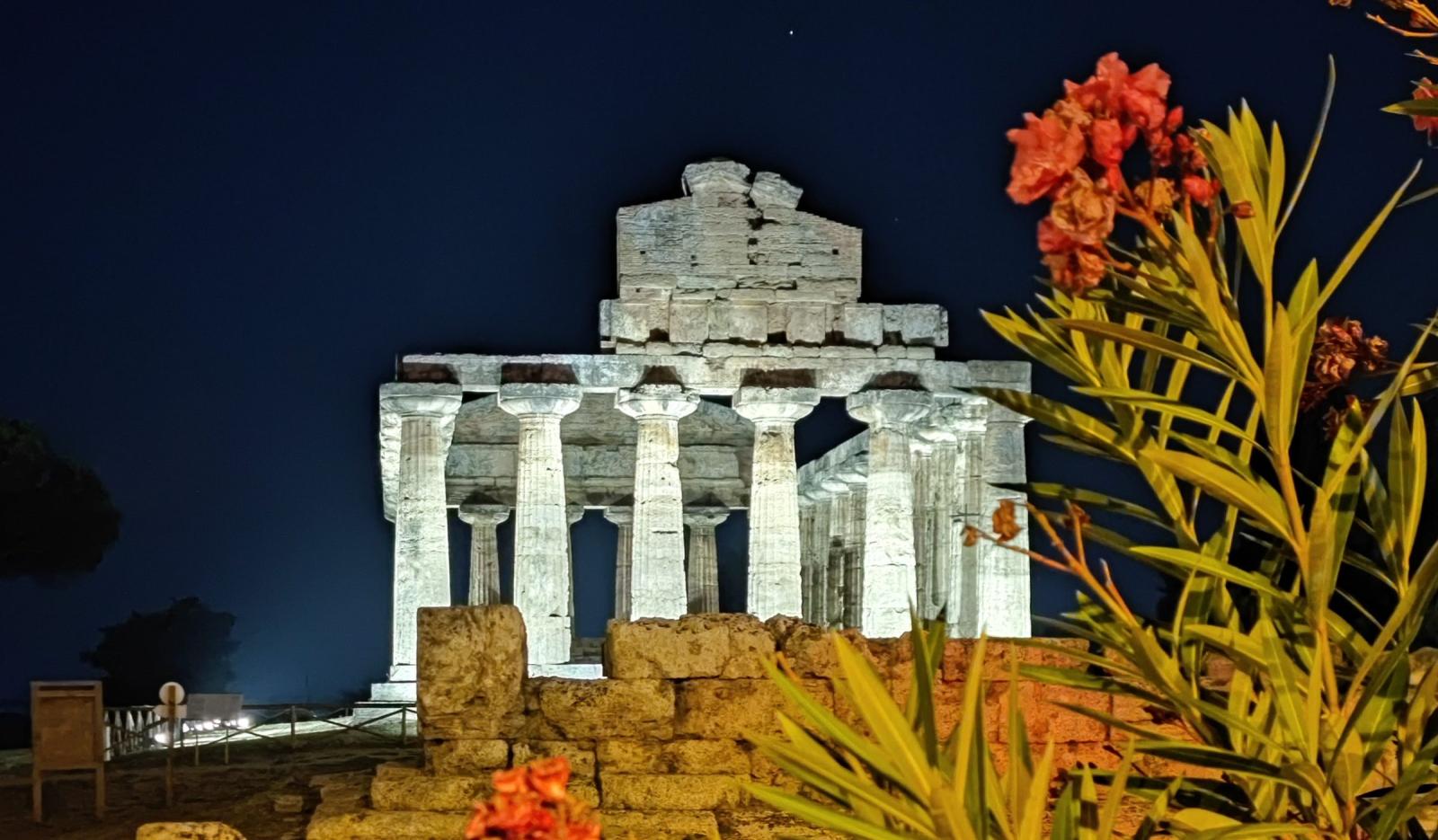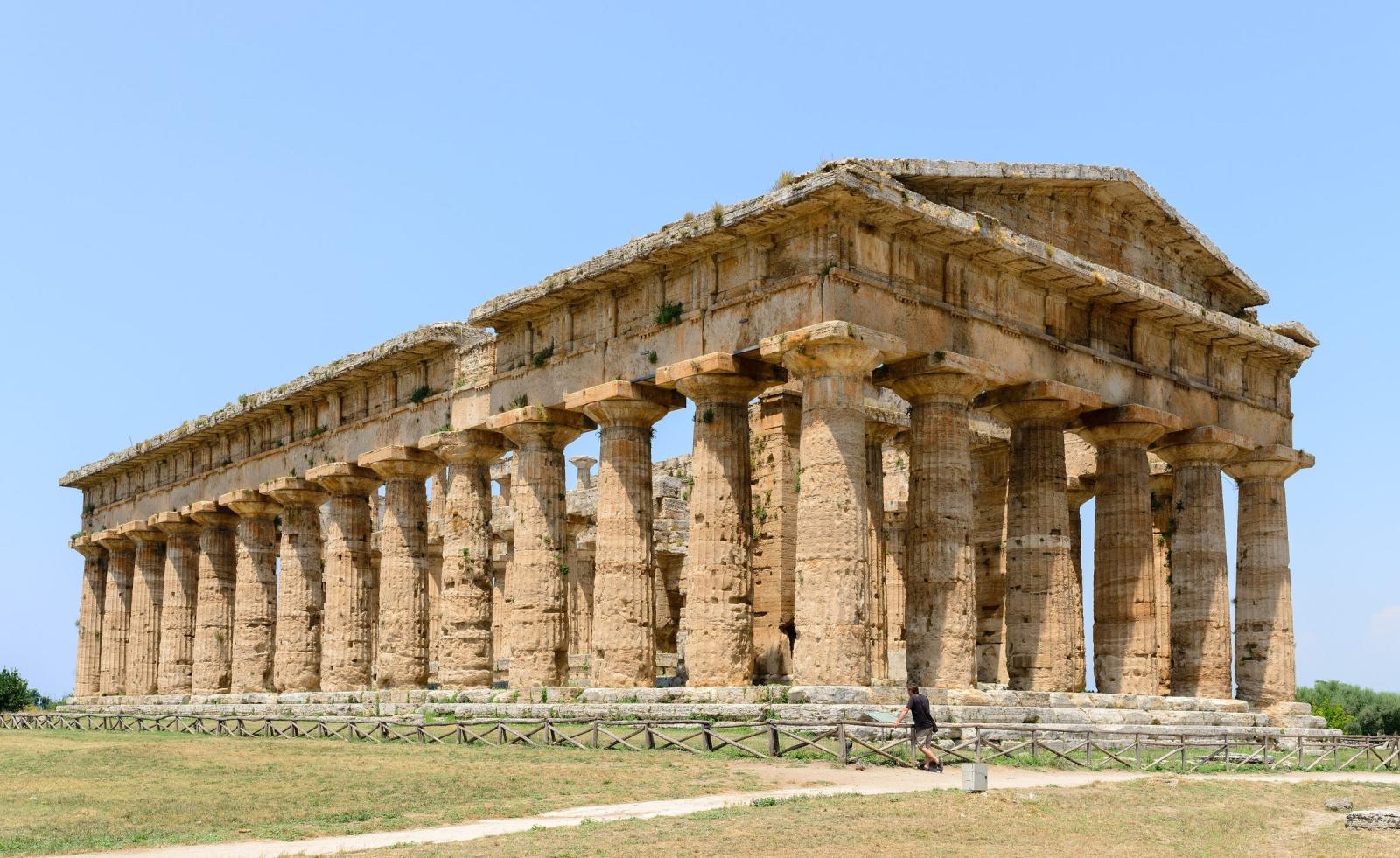
The Temples of Paestum are three Greek Doric temples built between roughly 550 and 450 BC in ancient Poseidonia, today Capaccio Paestum (Salerno), and a UNESCO World Heritage Site since 1998. A single ticket costs €15 (€10 from December to February), is valid for three days and includes the museum and Velia. From our B&B it is about a 10-minute drive.
The best time to go is the first hour after opening, when the plain is still quiet and the low sun warms the stone of the columns. This guide covers everything you need to plan your visit: the essential history, how to tell the three temples apart, what not to miss in the museum, tickets, opening hours and a few practical tips.
What is Paestum and why is it a UNESCO site?
Paestum was founded around 600 BC as Poseidonia, a colony established by Greeks from Sybaris and dedicated to Poseidon. Its position on the fertile Sele plain, close to the sea, soon made it one of the most prosperous cities of Magna Graecia. Between the late 5th and the 4th century BC it came under the control of the Lucanians, an Italic people from the interior; in 273 BC it became a Latin colony named Paestum and gained a forum, an amphitheatre and baths.
As the plain gradually turned to marshland the city lost its inhabitants, and in the early Middle Ages the population moved to the hills, where Capaccio was founded. The temples remained standing, alone in the countryside, until a new Bourbon road built in the mid-18th century brought them back to the attention of Grand Tour travellers: Piranesi drew them and Goethe visited in 1787.
Since 1998 Paestum has been on the World Heritage List together with the Cilento National Park, Velia and the Certosa di Padula (UNESCO listing).
What are the three temples and how do you tell them apart?
All three are built of local limestone and show, at a single glance, how Doric architecture evolved over roughly a century. Their familiar names date from the 18th century and, in two cases out of three, refer to the wrong deity.
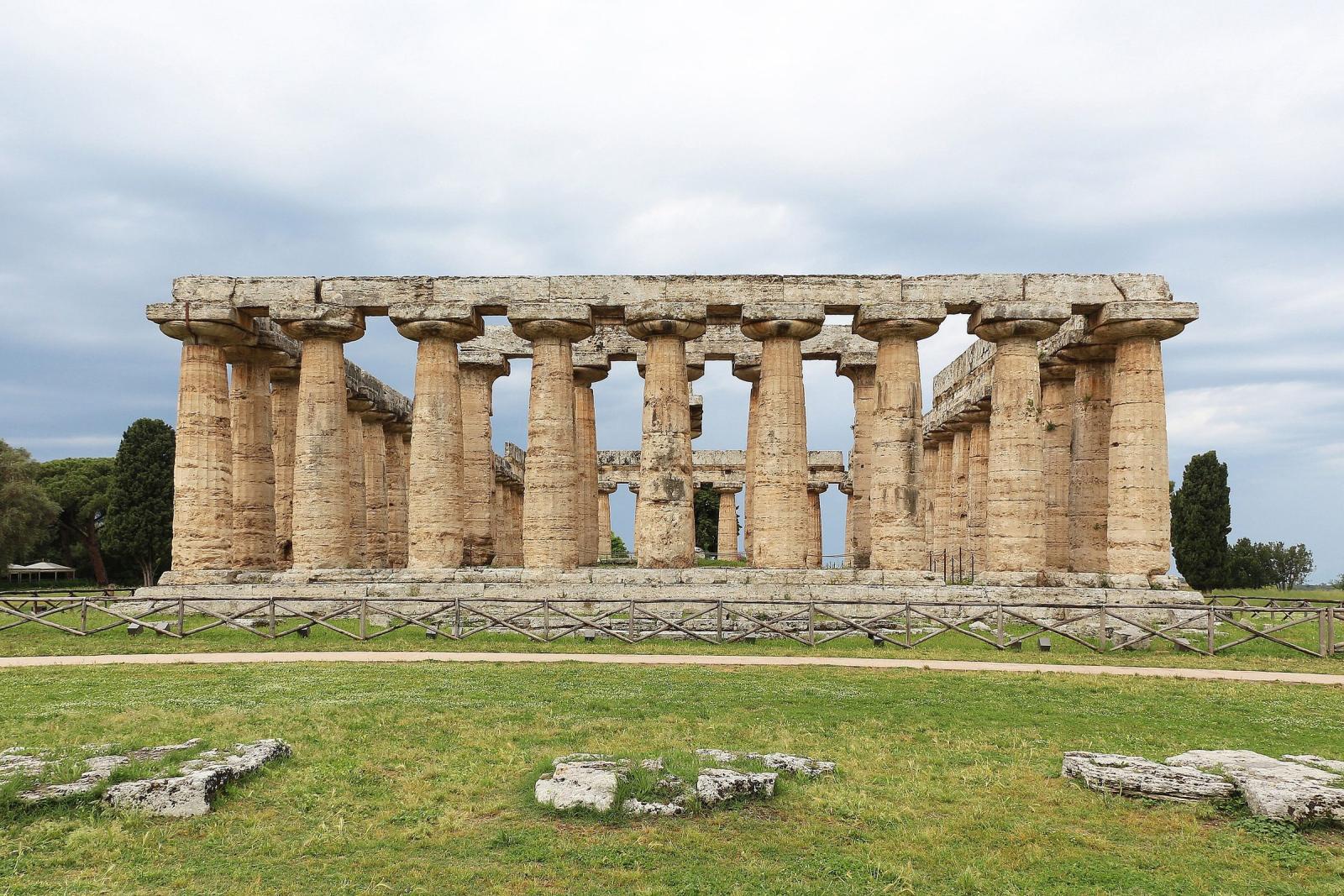
Temple of Hera I, the "Basilica" (c. 550 BC)
The oldest of the three. It has nine columns across the front and eighteen along the sides, an unusual plan that led 18th-century scholars to mistake it for a Roman basilica. The odd number of front columns matches a central row of columns inside the cella. Look closely at the shafts: the entasis, the slight swelling halfway up, is especially pronounced here, as is typical of archaic Doric.
Temple of Neptune, actually dedicated to Hera (c. 460-450 BC)
The largest and best preserved, and one of the most complete Doric temples in the Greek world. Six columns across the front and fourteen along the sides, each about nine metres tall, still carry much of the entablature; inside, the cella keeps its two superimposed tiers of columns. The attribution to Poseidon (Neptune) is an outdated 18th-century theory: in all likelihood this temple was also dedicated to Hera. It was built shortly before the Parthenon in Athens, begun in 447 BC, and is almost its contemporary.
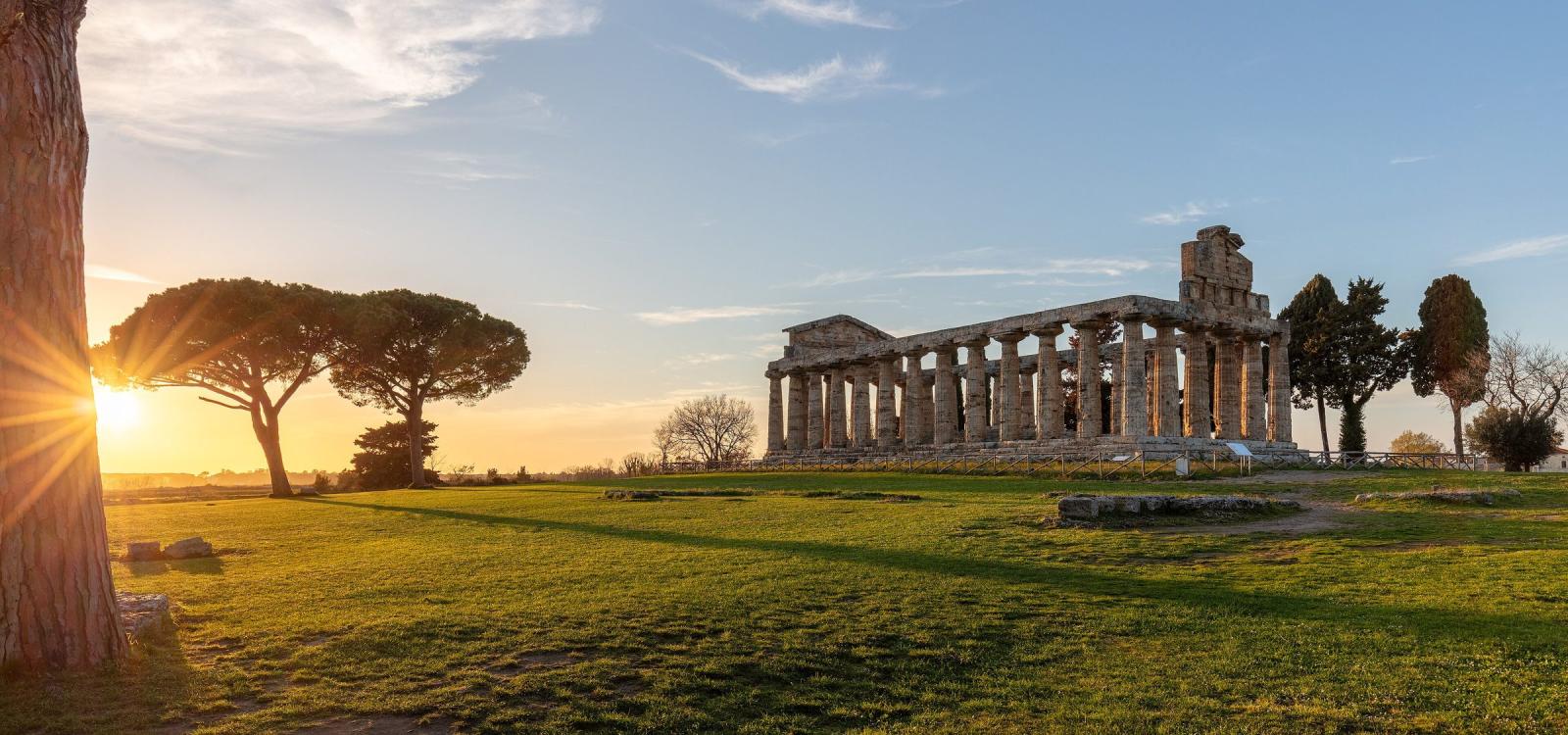
Temple of Athena, the "Temple of Ceres" (c. 500 BC)
The smallest of the three stands further north on a slight rise. For centuries it was attributed to Ceres; votive statuettes of Athena found nearby restored it to the goddess. Its distinctive feature is the mix of orders: a Doric exterior with Ionic columns in the pronaos, the entrance porch. It is a fine example of the freedom with which the colonies of Magna Graecia reinterpreted the models of the Greek mainland.
What should you see in the National Archaeological Museum?
The museum stands next to the archaeological area and is included in the same ticket. Allow at least an hour and a half: without the museum, the temples only tell half the story.
The Tomb of the Diver
The museum's most famous piece is a cist tomb from 480-470 BC made of five painted slabs. The walls show a symposium, with men reclining on banqueting couches, drinking, talking and playing music; on the lid a young man dives into water, an image usually read as a metaphor for the passage from life to death. It is the best-known example of Greek figurative painting from that period to survive outside painted pottery.
The metopes of the Heraion at the mouth of the Sele
From the sanctuary of Hera at the mouth of the Sele river, about nine kilometres from Paestum, come the 6th-century BC sandstone metopes depicting the labours of Heracles and episodes from the Trojan cycle. When the site is open, the park runs a Sunday shuttle to the sanctuary, by reservation; in autumn 2026, however, visits were suspended for maintenance (details in the box below).
The Lucanian paintings
The rooms devoted to the 4th-century BC necropolises display painted tomb slabs with horsemen, duels and farewell scenes: evidence of how the Lucanians, who succeeded the Greeks, developed a visual language of their own.
How much is the ticket and what are the opening hours?
A single ticket, valid for three days, covers the Paestum archaeological area, the museum and the archaeological park of Velia, about 45 kilometres away. It is worth spreading the visits over two days.
| Ticket | Single ticket valid for 3 days: Paestum archaeological area, National Archaeological Museum and Velia |
|---|---|
| Full price | €15 from March to November, €10 from December to February |
| Reduced | €2, on showing proof of eligibility |
| Free | Under-18s and 18- to 24-year-olds (until your 25th birthday) |
| Annual pass | €30 |
| Opening hours | Daily 8:30-19:30, last entry 18:30 |
| Reduced hours 2026-27 | From late September to late March the Porta Cerere entrance closes earlier; from 14 November 2026 to 1 January 2027 at 16:00 (last full visit at 15:00). The southern sanctuary remains open until 19:30. The calendar is renewed every year: check the official website |
| Free entry for everyone | First Sunday of every month, 25 April, 2 June and 4 November (2026 calendar; check the current year's) |
| Heraion shuttle | When running, it leaves on Sundays from Parcheggio Voza, is included in the ticket and must be booked by email. In autumn 2026 visits were suspended for maintenance: before you go, check the official Heraion page |
Source: Archaeological Parks of Paestum and Velia, ticket information. Hours and prices may change: please check before your visit.
How long do you need and when is the best time to go?
- Archaeological area only: 1.5-2 hours
- Archaeological area and museum: 3-4 hours (recommended)
- In-depth visit with a guide: half a day
The park is open all year. Spring (April to June) and early autumn (September to October) bring mild weather and fewer groups. In July and August go in at opening time: there is no shade on the plain and the midday heat is intense. Winter has a different charm, with morning mist between the columns, but between late September and late March the Porta Cerere entrance closes in the afternoon, so plan accordingly.
Start at the Temple of Athena in the north and work your way south: you will reach the "Basilica" and the Temple of Neptune as the light grows warmer. Keep the museum for the following day, since the ticket is valid for three days. Bring water and a hat, even in spring.
How do you get to the temples from Il Giardino dei Pini B&B?
Il Giardino dei Pini is on Via Filette in the Capaccio Scalo area, about 5 kilometres from the archaeological site: roughly a 10-minute drive. There are several car parks near the ancient walls. If you are travelling by train, Paestum station on the Salerno-Reggio Calabria line is a short distance from the walls.
Staying this close to the temples means you can see them at opening time, come back for a break by the pool during the hottest hours and return in the afternoon light. If you are planning your stay, have a look at our garden rooms.
What else is there to do in Paestum?
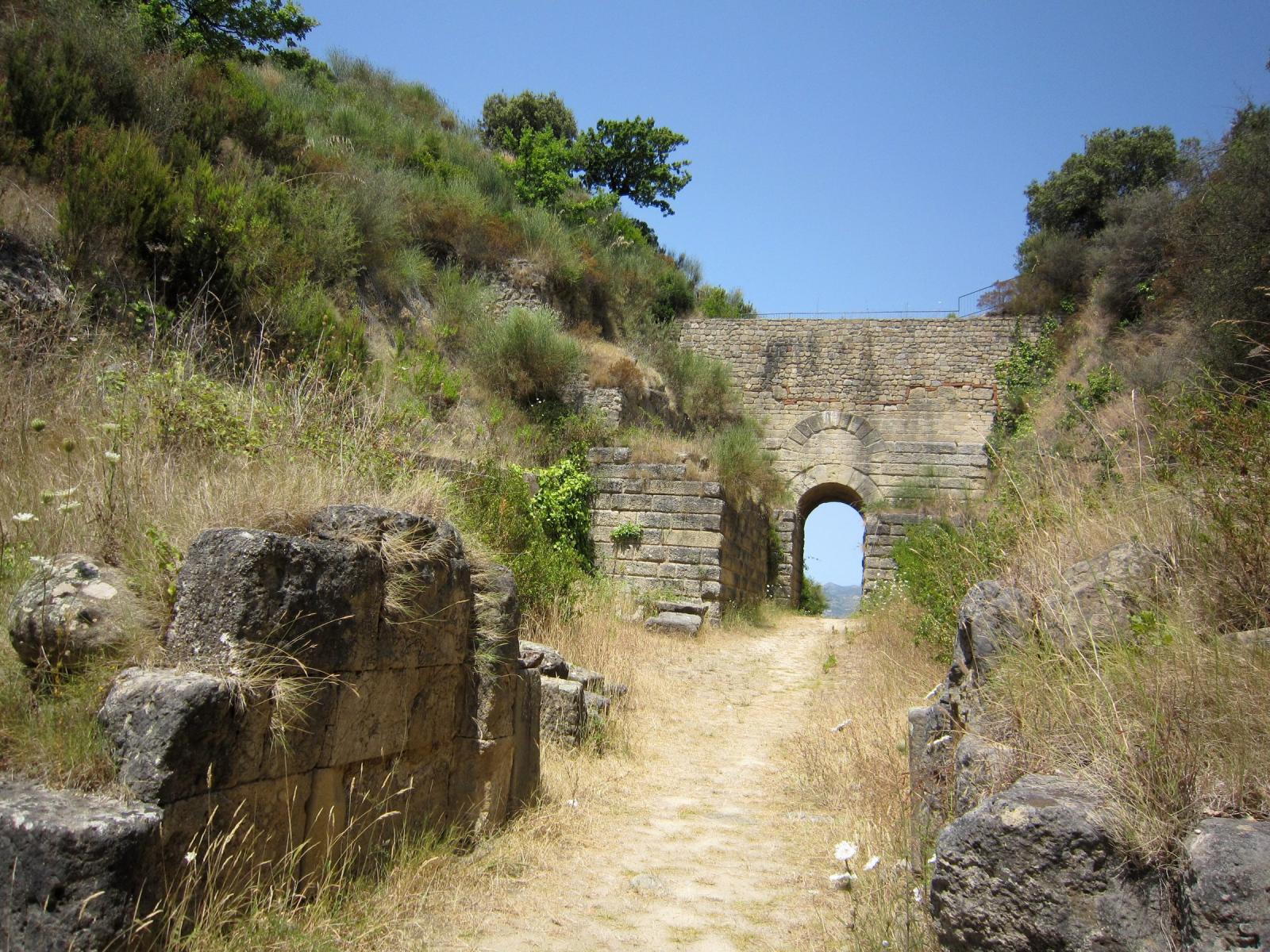
- The city walls: about 4.75 kilometres long, they enclose roughly 120 hectares and are among the best preserved in Magna Graecia. Some stretches can be walked and offer a different perspective on the ancient city.
- Buffalo mozzarella: the Sele plain is the heart of DOP production, and Tenuta Vannulo is about 5 minutes from the B&B. You will find addresses and tips in our guide to the dairies around Paestum.
- The sea: Paestum beach is about a 10-minute drive away; further south the coves of the Cilento begin, described in our guide to the best beaches near Paestum.
- Velia: with the same ticket, within three days, you can visit the city of Parmenides and the Porta Rosa.
Frequently asked questions
How much does a ticket to the Temples of Paestum cost?
According to the official website (November 2026), a full-price ticket costs €15 from March to November and €10 from December to February. It is valid for three days and covers the archaeological area, the National Archaeological Museum and Velia. It is free for under-18s and for 18- to 24-year-olds (until their 25th birthday); entry is free for everyone on the first Sunday of every month and, in the 2026 calendar, also on 25 April, 2 June and 4 November.
Is the Paestum ticket also valid for Velia?
Yes. The single ticket of the Archaeological Parks of Paestum and Velia is valid for three days and includes both sites, which are about 45 kilometres apart. It is best to give Velia a separate morning or afternoon.
How long does it take to visit Paestum?
The archaeological area takes 1.5-2 hours; with the museum, allow 3-4 hours. With a guide and time to linger, plan on half a day.
How far is Il Giardino dei Pini B&B from the temples?
The B&B is in Capaccio Scalo, about 5 kilometres from the archaeological area: around 10 minutes by car, with car parks near the walls.